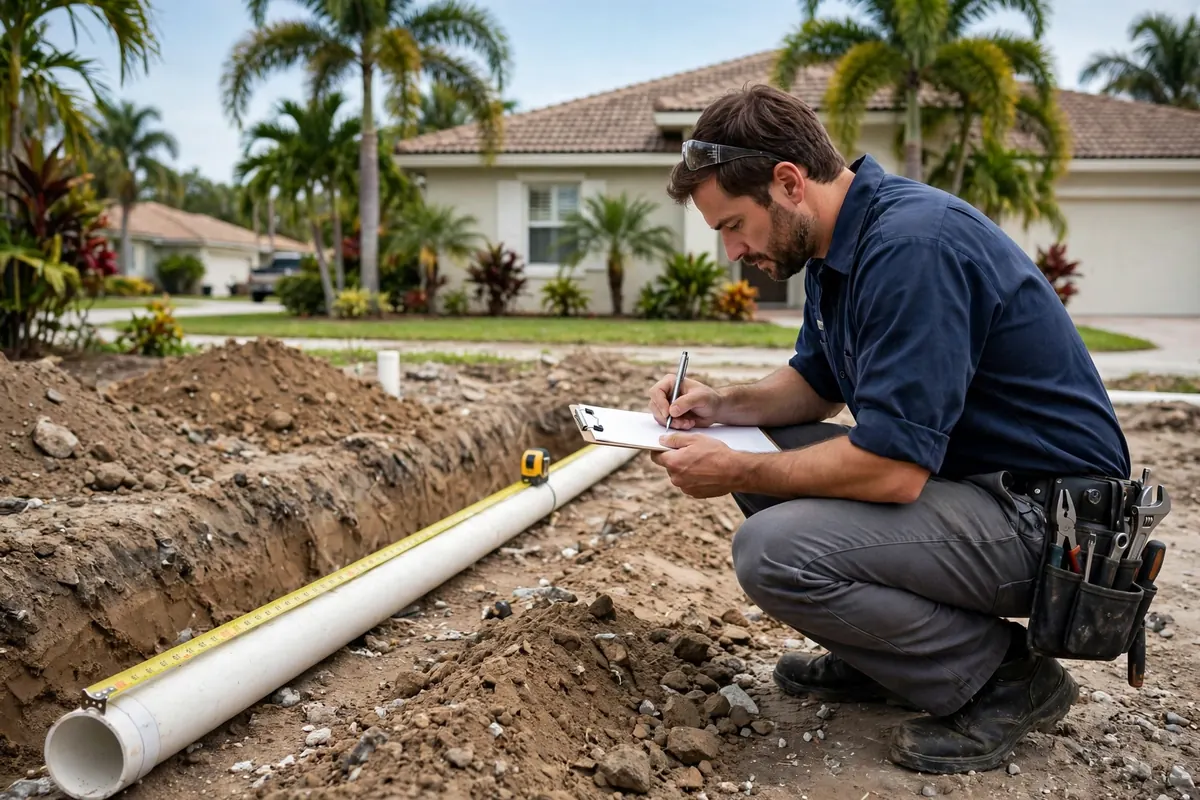
What sewer line repair work involves depends on the repair method, the pipe's length and depth, its material and condition, how many spots are damaged, and how easy the line is to reach. A camera inspection answers those questions first, because no one can plan the job without seeing what is buried underground.
| Scenario | Situation | Fix | Disruption |
|---|---|---|---|
| Simple spot repair | 1962 ranch in Samoset; one cracked clay section under an open side yard; single offset joint at 22 feet | One excavation, one new pipe section, backfill and sod | One day, minimal restoration |
| Trenchless lining candidate | Bayshore Gardens home; 60 feet of clay lateral, root intrusion at three joints, pipe still holding its shape | Lining the full run through two small access points | One day of work, yard intact |
| Full traditional replacement | Waterfront property near the Manatee River; collapsed Orangeburg lateral at seven feet deep, under a paver driveway, high water table needing dewatering | Full excavation, new HDPE pipe, dewatering throughout, driveway restoration | Multiple days, multiple trades |
Why Nobody Can Plan Your Repair Over the Phone
Anyone who gives you a firm number without a camera inspection is guessing. Your sewer lateral, the pipe running from your house to the county main, is buried, and everything about the job depends on what's down there. How deep is the pipe? What's it made of? Where exactly is it broken, and how many spots are bad? Manatee County Utilities describes the county sewer system and where the public main takes over from your lateral, which is the boundary every plan has to respect.
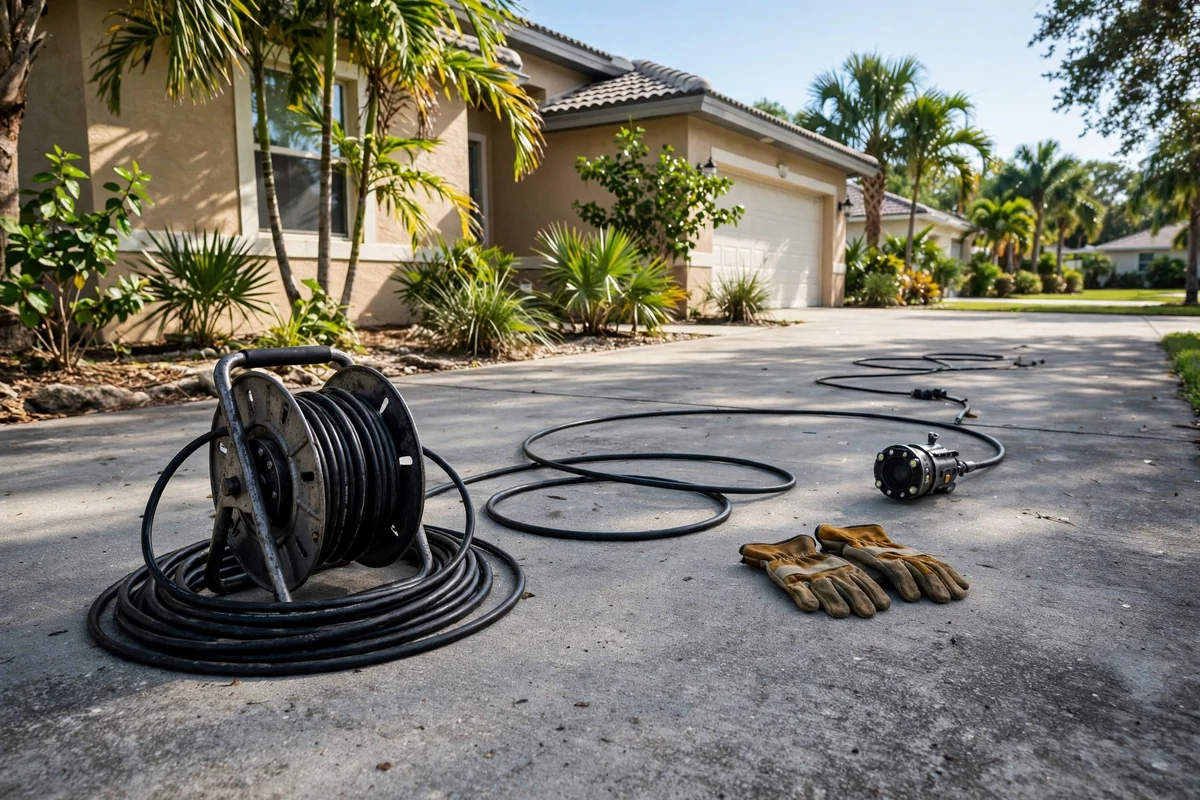
A camera inspection answers all of that in about an hour. Until someone has eyes inside your line, any plan is a placeholder. Be wary of companies that plan low on the phone and "discover" problems once the trench is open. The honest sequence is always: inspect first, diagnose second, plan third.
The Repair Method Changes Everything
The single biggest work driver is how the repair gets done. A small spot repair, digging up one bad section and replacing a few feet of pipe, is a fundamentally different job than replacing the entire lateral from house to street.
Trenchless methods like pipe lining (CIPP) and pipe bursting usually work more per foot of pipe than open-trench digging. But that comparison misses the real math. Trenchless doesn't tear up your driveway, your pavers, your oak trees, or your landscaping, and restoring all of that after a traditional dig can work as much as the pipe work itself. In neighborhoods like Bayshore Gardens or the Village of the Arts, where mature landscaping and hardscaping are half the property's charm, the "simpler" dig can quietly become the major option.
Traditional excavation is still the right call in some cases: collapsed pipes, severe bellies, or lines that have lost their grade. The point isn't that one method is always simpler. It's that the method has to match the problem, and the total work has to include putting your property back together.
Depth, Length, and Access: The Three Physical Factors
Three physical realities of your property shape the plan more than almost anything else:
- Depth. A lateral buried three feet down is a half-day dig. The same pipe at eight feet needs shoring, bigger equipment, and serious safety precautions. Deeper almost always means pricier.
- Length. A 20-foot run to a nearby main is a different project than a 90-foot run across a big lot. More pipe, more labor, more material. This is one reason rural properties in places like Myakka City can surprise owners. Long private runs add up.
- Access. Can equipment reach the line, or is it under your pool deck, your garage slab, or a heritage oak you can't remove? Tight access slows everything down and sometimes forces a more major method. Lines running under slabs are a special headache, the work has to happen from inside or through carefully cut access points.
What Bradenton's Soil and Water Table Add to the Job
Florida's sandy soil doesn't hold a trench the way clay soil does. It shifts, it settles, and it lets pipes develop bellies, low spots where waste collects instead of flowing. When we dig in Manatee County, we deal with sand that wants to cave and a water table that can sit just a few feet down, especially near the Manatee River, Sarasota Bay, or the barrier islands.
High groundwater means dewatering. Pumping water out of the trench so the crew can work. It means bedding the new pipe properly so it doesn't settle into the muck. None of this is exotic, but it's real labor and real material, and plans that ignore it tend to grow mid-job. A contractor who mentions your water table during the assessment is one who's actually thought about your property.
On Anna Maria Island, Holmes Beach, and Bradenton Beach, elevation can be near zero. Everything is harder when the pipe is practically at sea level. Island jobs also involve mobilization logistics, equipment and materials have to cross the bridge. None of this is a reason to panic; it's just why island plans run higher.
Every line is different, so every job is scoped on what the camera shows — call and tell us what you are seeing.
Call (941) 214-9486Pipe Material and Condition Matter More Than Age Alone
What your pipe is made of changes the repair options: and the plan. Clay tile with offset joints might be a candidate for lining. Collapsed Orangeburg (a tar-paper pipe used in some mid-century homes) usually can't be lined at all and needs full replacement. Cast iron that's just scaled up inside can often be descaled and saved; cast iron that's rusted through needs to go.
This is why "my neighbor paid X" is a useless benchmark. Your neighbor's 40 feet of PVC with one root intrusion is not your 70 feet of crumbling cast iron under a concrete patio. Same street, wildly different jobs.
Permits, Inspections, and the Stuff Nobody Mentions
Legitimate sewer work in Manatee County involves permits and inspections. That takes time and coordination, and any plan that skips it should worry you. Unpermitted sewer work can become your problem at resale, when a buyer's inspection flags it. Manatee County's licensing and permits pages set out how to apply for and manage building permits, including the inspection that must happen before backfill.
Also ask what's included: Does the plan cover the camera inspection, or is that separate? Is landscape and hardscape restoration included, or do you get a trench and a handshake? Is the cleanout installation part of the job? The simplest plan on paper is often the one with the most exclusions in the fine print.
How to Read a Scope Without Getting Burned
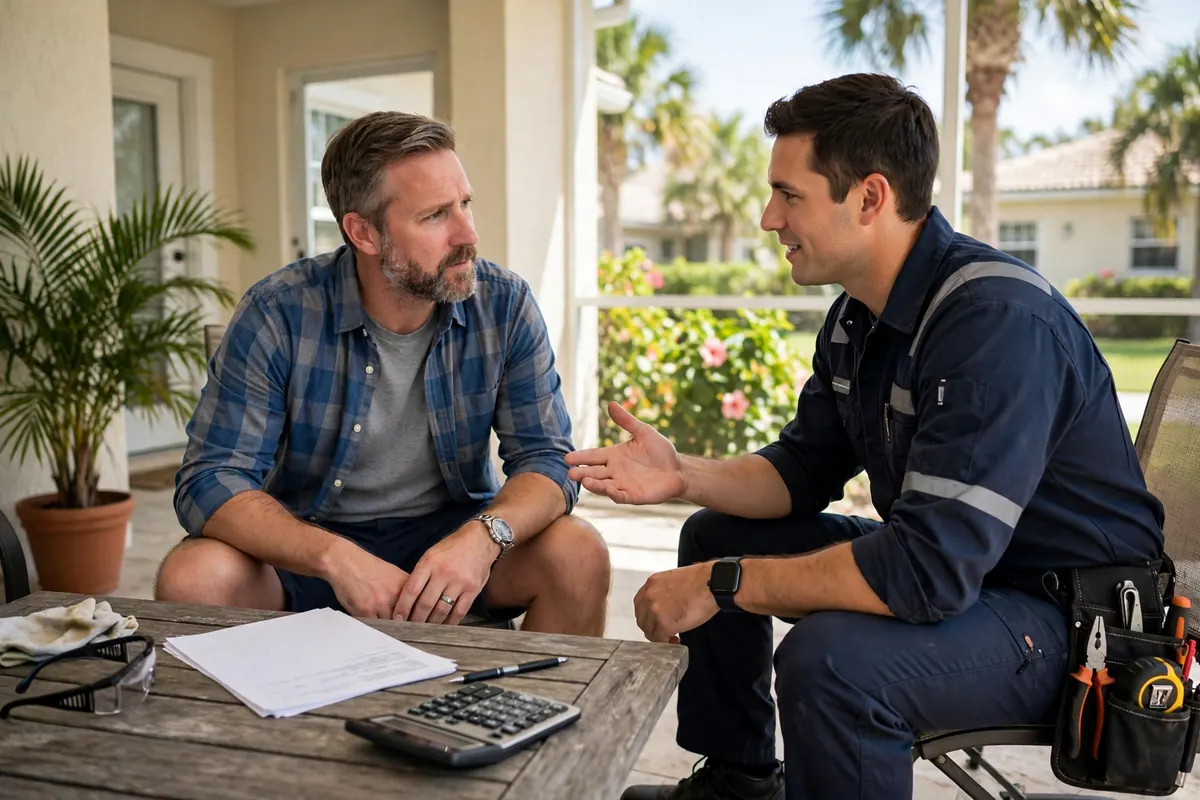
Get at least two or three plans, and make sure they're quoting the same scope. One contractor's "full replacement" might mean house-to-main; another's might stop at the property line. Ask each one: What method, and why this method for my pipe? How many feet, at what depth? What's the warranty: on the pipe, and on the labor? What happens to my yard, driveway, and landscaping, and who's responsible for putting it back?
Watch for the classic traps: a plan that's dramatically lower than the others (something's excluded), pressure to sign today for a "discount," and any contractor who won't put the scope in writing. A sewer line is a 50-year decision. An extra week of diligence now is smart insurance.
The honest bottom line: in Bradenton, a minor spot repair and a full traditional replacement live in completely different jobs. What matters isn't the number. It's understanding why your number is what it is. Any contractor worth hiring can walk you through that without flinching.
Three Realistic Scenarios (Same County, Different Jobs)
To make this concrete without inventing prices, picture three actual situations we see regularly:
- The simple spot repair. A 1962 ranch in Samoset with one cracked clay section under an open side yard. Camera finds a single offset joint at 22 feet. The fix: one excavation, one new section of pipe, backfill and sod. One day, minimal restoration, done.
- The trenchless lining candidate. A Bayshore Gardens home with 60 feet of clay lateral, root intrusion at three joints, but the pipe still holding its shape. The fix: lining the full run through two small access points. No trench across the mid-century landscaping the owners spent years cultivating. One day of work, yard intact.
- The full traditional replacement. A waterfront property near the Manatee River with a collapsed Orangeburg lateral at seven feet deep, running under a paver driveway, high water table requiring dewatering. The fix: full excavation, new HDPE pipe, dewatering throughout, then driveway restoration. Multiple days, multiple trades, real money.
Same county, same "sewer line repair": three completely different projects. This is why your neighbor's bill tells you nothing about yours, and why any contractor quoting without footage is selling you a fantasy.
When You Can't Do It All at Once: Phasing and Priorities
Sometimes the camera reveals a lateral with problems along its whole length and the plan doesn't stretch to a full replacement right now. That's a legitimate situation, and there are honest ways to handle it:
- Fix the worst first. A spot repair on the collapsed section restores function now; the deteriorated-but-working sections get monitored and scheduled later. Not ideal, but far better than doing nothing.
- Clean and maintain as a bridge. Hydro jetting plus a maintenance plan can keep a marginal line working for years while you plan for the real fix. It's honest interim care, not a solution, and any contractor should say so plainly.
- Ask about phasing explicitly. "If I fix the critical section now, what does the rest look like in two years?" A good contractor will give you a staged plan with real priorities instead of all-or-nothing pressure.
What you shouldn't do: patch the same failing line with emergency clearings for years. Add up those service calls. Homeowners are often shocked to learn how much temporary relief has added up to. At some point the math flips, and it's worth doing that math early.
Need help with your sewer line?
We serve Bradenton and all of Manatee County. A camera inspection is the fastest way to know what's going on.
Call (941) 214-9486