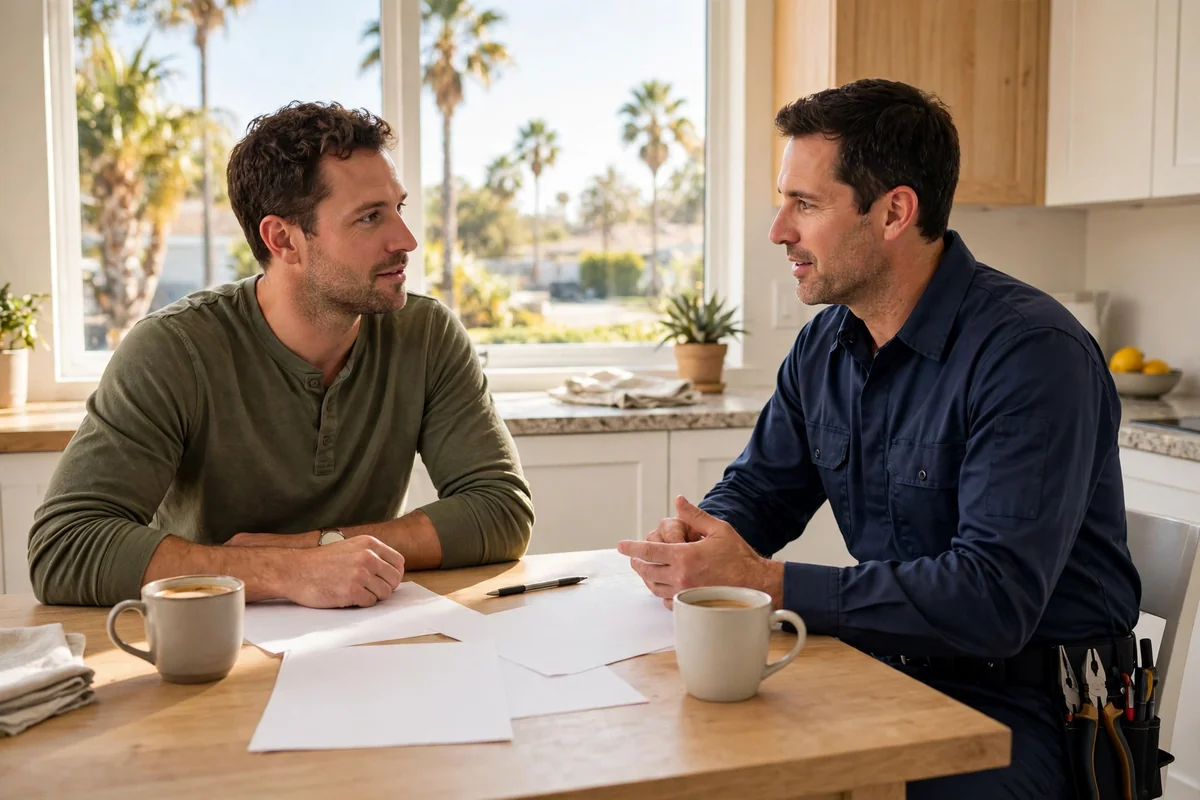
Before signing a sewer repair contract, ask to see the camera footage, ask why the contractor recommends this method over the alternatives, and ask what the plan includes for restoration and permits. A trustworthy contractor answers with evidence you can see, not with pressure to sign the same day.


1. "Can I See the Camera Footage?"
This is the foundation everything else rests on. A contractor diagnosing your lateral without camera footage is guessing, and you don't sign five-figure contracts based on guesses. Ask to see the inspection: the cracks, the roots, the belly, measured in feet from the access point.
Watch for: contractors who "lost" the footage, who describe problems vividly but can't show them, or who did a quick look but won't share the recording. A reputable company treats the footage as yours. You paid for the inspection, the evidence belongs to you. Get a copy. If you get a second plan, that footage lets the next contractor bid on facts instead of starting over.
2. "Why This Method and Not the Alternative?"
For most sewer problems, more than one fix exists. Lining vs. bursting vs. traditional dig vs. spot repair. Each has a real engineering rationale, and the contractor should be able to explain theirs in plain language tied to your footage. "The pipe is collapsed at 38 feet with a belly at 55, so lining can't correct the grade. That's why we're recommending excavation" is an answer. "This is what we do" is not.
Be especially alert when a company only offers one method. A trenchless-only shop will recommend trenchless for everything; a dig-only crew will find reasons to dig. Neither is automatically wrong, but a one-method contractor can't give you an unbiased recommendation. Our trenchless vs. traditional comparison covers how the methods actually differ.
3. "What Exactly Is Included and Excluded?"
The plan says $X. But does $X include the camera inspection? Permits and inspection requirements? The cleanout installation? Backfill compaction? Landscape, driveway, and hardscape restoration, and to what standard? ("Rough grade" and "restored to original condition" are very different promises.)
Exclusions are where incomplete plans hide their real scope. Ask directly: "What could come up beyond this plan?" Honest answers include things like "if we find the line is deeper than the camera suggested" or "irrigation repairs beyond the trench path." Vague answers, "don't worry, this covers everything", should worry you.
4. "What Warranty Do I Get: on the Pipe and on the Labor?"
These are two different warranties and you need both in writing. The pipe material warranty comes from the manufacturer (PVC and HDPE carry long manufacturer warranties). The workmanship warranty comes from the contractor and covers installation defects: bad joints, improper slope, settlement from poor compaction.
Ask: How many years on labor? What voids it? Is it transferable if I sell the house? (A transferable warranty is a genuine selling point at resale.) Get the terms in the contract, not in a verbal promise. Verbal warranties are worth the paper they're printed on.
5. "Who Pulls the Permits, and Will It Be Inspected?"
In Manatee County, legitimate sewer lateral work requires permits and is subject to inspection. The contractor should handle permitting as part of the job. It's routine for them. If a contractor suggests skipping permits "to save you money," that's a red flag the size of a trench. The Florida Department of Business and Professional Regulation runs the license lookup where you can verify a contractor license before signing anything.
Unpermitted sewer work becomes your problem at resale, when a buyer's inspection or title search flags it. It can also complicate any future insurance claim. The permit step is simple; the protection is large. Confirm in writing that permits and inspections are included. Manatee County's licensing and permits pages explain how to apply for and manage building permits for lateral work.
Asking the right questions is half the job — call and ask us yours before you sign anything.
Call (941) 214-94866. "What Happens to My Property During and After the Work?"
Where will equipment be staged? How do they protect the driveway from heavy machinery? What happens to the oak tree near the trench path? How long will water/sewer service be interrupted, and will you be notified in advance?
For traditional digs especially, restoration deserves its own line items: sod type and coverage area, paver reinstallation, irrigation repair, debris removal. "We'll put it back how we found it" is a nice sentence. The contract should say what "how we found it" means, ideally with before photos taken at the start of the job.
7. "Can I Have References and Time to Decide?"
Two asks in one, because they test the same thing: confidence. A contractor with happy customers hands over references without blinking. A contractor with a fair plan doesn't need you to sign tonight. The "today-only discount" is pressure, not generosity.
Sewer emergencies feel urgent, and sometimes they are (active backup = act now). But most lateral problems, the slow drains, the root intrusion found on inspection, give you days to decide, not minutes. Use them. Get a second plan. Sleep on it. The pipe waited this long; it can wait through the weekend while you do your homework.
Red Flags That Should Stop You Cold
Beyond the questions, watch for these: demanding full approval upfront (deposits are normal; full pre-approval is not), no written contract at all, bids dramatically lower than everyone else's, unwillingness to show camera footage, and any reluctance about permits. Any one of these is worth walking away over. A sewer line is a 50-year decision. The contractor who respects that will respect your questions too.
The Line-Item Checklist: Comparing Plans Fairly
When the plans come in, lay them side by side against this checklist. Every plan should answer every line, blanks are information:
- Method and why: lining, bursting, dig, or spot repair, with the engineering reason tied to your footage.
- Linear feet and depth: how much pipe, how deep. Vague quantities hide vague plan.
- Pipe material and diameter: what's going in the ground (PVC? HDPE? what schedule/rating?).
- Access points: where they'll dig or enter, and what surface gets disturbed.
- Permits and inspections: included, with the issuing jurisdiction named.
- Restoration scope: exactly what surfaces, to what standard, whose responsibility.
- Warranties: manufacturer and workmanship, years, transferability, exclusions, in writing.
- Schedule: deposit amount, progress terms, final approval tied to completion and inspection.
- Timeline: start date, working days, what counts as done.
- Exclusions: what's not included, the most honest line on any plan.
A plan missing half of these isn't a plan. It's a number. Ask for the rest before comparing.
After You Sign: Protecting Yourself During the Job
Signing well is half the battle; the other half is staying engaged while the work happens:
- Take before photos of the yard, driveway, and any structures near the work path. Date-stamped. This is your restoration baseline.
- Confirm the utility locates happened before any digging. In Florida, Sunshine 811. It's the law, and it protects your property and the crew.
- Ask to see the finished work before backfill. For open-trench jobs, looking at the new pipe in the trench before it's buried is your right. Check the slope looks right, joints look clean, bedding looks proper. You don't need to be an engineer to spot sloppiness.
- Get the final camera footage. After lining or replacement, a post-job camera run proves the work is correct. Reputable companies do this as standard practice. Ask for the recording.
- Don't release final approval until the work passes inspection, the site is restored per the contract, and you have warranty documents in hand. Money is leverage; spend it last.
None of this is adversarial. Good contractors welcome engaged homeowners. It's the ones who discourage your involvement that you needed the questions for in the first place.
Trust Your Gut, Then Verify It
After all the questions and checklists, one factor remains: how the contractor made you feel. Did they explain or lecture? Did they welcome questions or rush past them? Did the footage match the story? Good contractors are patient because they're confident. The ones worth hiring treat your caution as intelligence, not insult, because it is.
Need help with your sewer line?
We serve Bradenton and all of Manatee County. A camera inspection is the fastest way to know what's going on.
Call (941) 214-9486